Case study
Braadbaas: an SEO and GEO audit for a Shopify store ranking for 1,900 keywords
Braadbaas is an online cookware store in Maassluis, the Netherlands, selling pans, knives, and barbecue gear from brands like Demeyere, De Buyer, and Skottsberg, built on Shopify. In July 2026, we delivered its SEO and GEO (generative engine optimization) audit: a technical analysis of the store, a content analysis for Google and AI search engines, and an implementation guide the Braadbaas team uses to roll out the fixes themselves. The biggest find: product pages with 47,000 lines of HTML, which meant Google no longer read the Product schema.
- Industry
- E-commerce, cookware, Shopify
- Market
- The Netherlands
- Services
- SEO and GEO audit, technical implementation guide, executive summary
- Period
- Audit delivered July 2026, implementation by Braadbaas in progress
Why a Shopify store ranking for 1,900 keywords still needed an SEO audit
Braadbaas already ranks for hundreds of product names and brand terms; the store shows up in Google for more than 1,900 keywords. The question wasn't whether the store gets found, but why certain categories lagged behind competitors like Kookwinkel.nl and Kookpunt, and whether the store was ready for AI search engines that recommend products.
A Shopify store comes with its own set of problems: themes and apps that add code nobody keeps track of anymore, reviews and variants rendered inline on every product page, and schema placed by an app without anyone checking whether Google still reads it.
How the SEO and GEO audit of the Shopify store was done
We started with a full crawl of the store using our in-house crawler, LibreCrawl, connected to Google Search Console, plus an analysis of keywords and competitors in the cookware market. That produced an audit with three layers: technical SEO (crawlability, indexing, speed, schema), content for Google and AI (category copy, blog posts, and product information a model can cite), and external authority.
The most important technical finding only surfaced when we checked the schema: on product pages with lots of reviews and variants, the Product schema sat at the bottom of a document of roughly 47,000 lines of HTML, so Google's Rich Results Test never reached it. The cause: every review rendered inline, detailed per-country shipping information in the schema, and every product variant written out in full. The recommendation: move the Product schema into the page head, paginate reviews, trim ShippingDetails, and stop rendering every variant inline.
Each finding got a label, template fix (applies to every page at once) or page fix, so the team knew what would have the most impact. The audit went to Jeroen Kwekel for implementation, along with a separate two to three page executive summary for Bo van der Voort and Michael Woensdregt.
What the SEO and GEO audit for Braadbaas covered
- 01Full crawl of braadbaas.nl with LibreCrawl, connected to Search Console data.
- 02Keyword and competitor analysis for the cookware market: induction frying pans, PFAS-free cookware, Japanese chef's knives, pizza stones, and barbecue accessories; benchmarked against Kookwinkel.nl, Kookpunt, Kookgigant, Meesterslijpers, and BBQ Experience Center.
- 03Technical audit: crawlability, indexing, internal links, load time, and schema validation with validator.schema.org and the Rich Results Test.
- 04Diagnosis and fix for the 47,000-line product pages: Product schema in the head, review pagination, trimmed ShippingDetails, no inline variants.
- 05Content and GEO analysis: which category and product information an AI model can cite, and where the store is currently invisible for questions like “which frying pan works on induction.”
- 06Technical implementation guide for the Shopify team, separating template fixes from page fixes.
- 07Executive summary for the owners.
- 08Follow-up call on July 24, 2026, about progress; by then, most of the recommendations had already been implemented.
The result: Product schema Google can read again
Braadbaas has implemented most of the audit recommendations on its own and is working through the rest, including slimming down the product pages. The before-and-after measurement will follow once the bulk of the fixes are live.
- 1,900+
- keywords braadbaas.nl ranked for at the start of implementation (September 2026)
- 47,000
- lines of HTML per product page at the time of the audit; the reason Google didn't read the Product schema
Which online stores need an SEO and GEO audit
Any Shopify store with lots of reviews and variants runs the risk that its schema and content become unreachable for Google and AI models without anyone noticing: the page loads, the app says the schema is in place, and the Rich Results Test says otherwise. That's why an SEO audit for an online store has to go beyond a checklist: check the rendered page the way Google sees it, and separate template-level fixes from fixes on individual pages.
See it for yourself
The work is live at Braadbaas
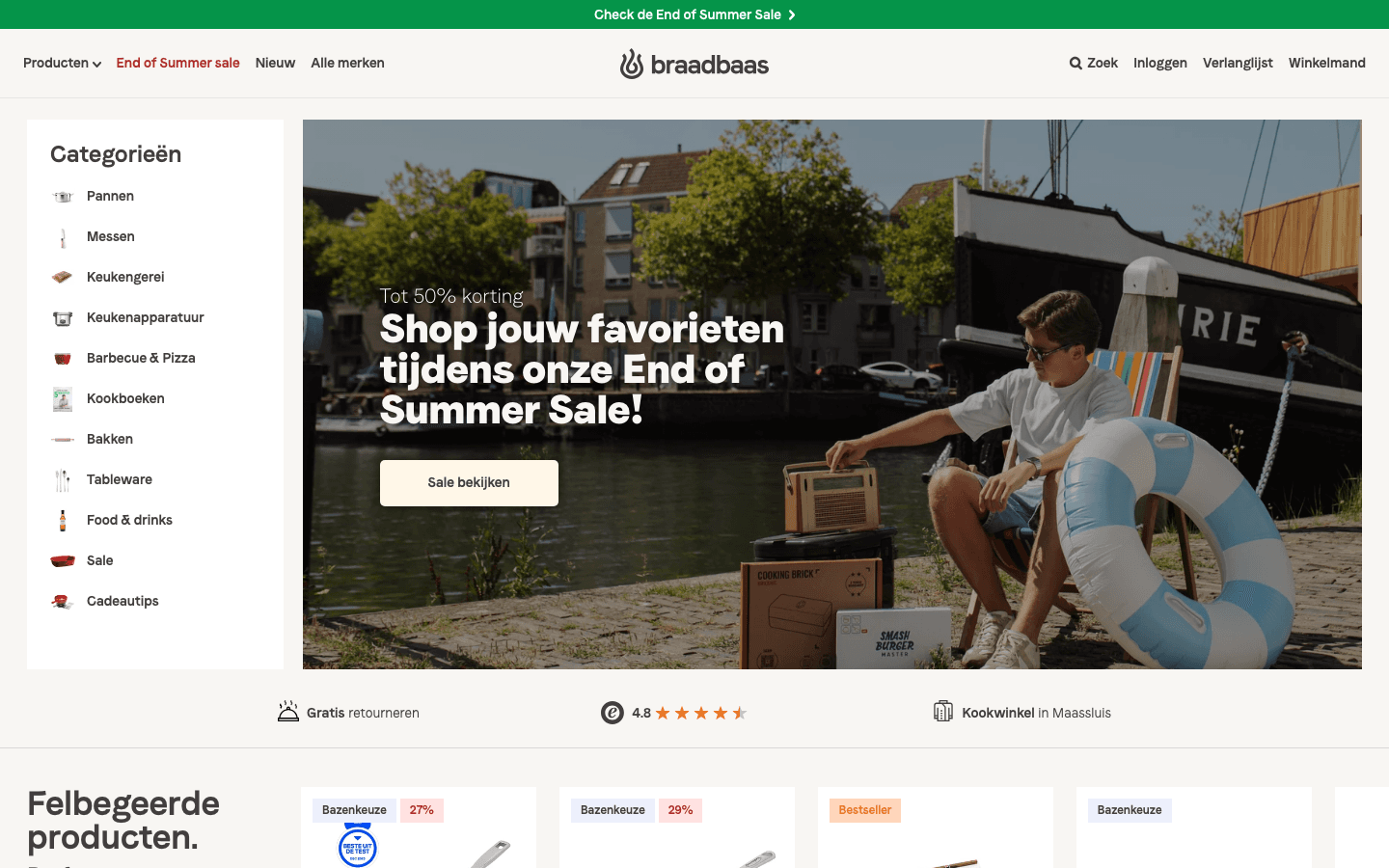
The online store the audit was made for.
FAQ
Frequently asked questions about SEO audits for Shopify stores
What's included in an SEO audit for an online store?+
A technical analysis (crawlability, indexing, load time, schema), a content analysis (category and product pages, blog posts, what an AI model can cite), and an analysis of external authority, turned into an implementation guide with fixes at the template level and per page. For Braadbaas, one result was the discovery that Google no longer read the Product schema on pages with 47,000 lines of HTML.
Why doesn't Google read the schema on my Shopify product page?+
Usually because the page is too large: reviews rendered inline, per-country shipping details in the schema, and every variant written out in full. Google and its testing tools then never reach the end of the page, where the schema sits. The fix is to place the Product schema in the head, paginate reviews, trim ShippingDetails, and stop rendering every variant inline.
What is GEO for an online store?+
GEO (generative engine optimization) makes sure ChatGPT, Perplexity, and Google AI Overviews recommend your products or your store for questions like “which frying pan works on induction.” That takes product information a model can cite (material, compatibility, dimensions, price with a date), readable schema, and content that answers the buying question instead of just describing the product.

Get started
Find out what's holding your online store back in Google and AI
An SEO and GEO audit that goes beyond the checklist: the page as Google actually sees it, template-level fixes, and a guide your team can implement on its own.