Research · October 6, 2026
Does ChatGPT use Google results? What 1,200 answers show
400 Dutch-language questions without a brand name, 3 runs per chatbot, measured through the APIs of ChatGPT, Gemini, and Perplexity and compared with Google's results from the same day.
Matt Timmermans, Timmermans Media. Measured: September 26, 2026. Preregistration: doi.org/10.5281/zenodo.22974863. Data: doi.org/10.5281/zenodo.23010967.
Does ChatGPT use Google results? Its sources overlap little with them: in 128 of 1,200 ChatGPT answers (10.7%), at least one page from Google's top 3 was among the sources, versus 207 of 1,200 Gemini answers (17.3%). A high Google ranking for the matching search term does not mean ChatGPT will also cite that page. Higher-ranked pages were cited more often than lower-ranked ones, but even the No. 1 result on Google went uncited in most answers.
ChatGPT writes its own search queries. For purchase questions, the API logged an average of 9.5 search queries per answer, and in 84% of those answers at least one query contained a brand name that was not in the question. ChatGPT then often cites a different page from the one at the top of Google, sometimes on the same website. The results apply to the APIs on September 26, 2026; the apps and Google AI Overviews were not studied.
The findings
Google rankings and AI sources: the findings at a glance
of 1,200 ChatGPT answers:
that many answers (10.7%) had at least one page from Google's top 3 among their sources. For Gemini it was 207 of 1,200 (17.3%). Supplementary count.
Position matters, but from a low base:
the No. 1 result on Google was cited in 6.7% of ChatGPT answers, the No. 10 result in 0.5%.
ChatGPT searches with brand names:
in 84% of purchase answers, at least one search query contained a brand name that was not in the question.
The same website more often than the same page:
the website of a top 3 page was cited in 10.8% of ChatGPT answers on average, the exact page in 4.0%.
In short: for 400 Dutch-language questions, each asked three times through the API, 128 of 1,200 ChatGPT answers had at least one page from Google's top 3 among their sources. The preregistered primary measure, the probability that one specific top 3 page is cited, averaged 4.0% for ChatGPT and 8.1% for Gemini. Measured September 26, 2026, with Google results from the same day. The study measures overlap, not why a chatbot chooses a source.
The full study this publication is part of consists of 6,120 answers. This publication uses the baseline measurement: 400 questions, 3 runs, 1,200 answers per chatbot, plus the Google results for 400 search terms. Percentages are weighted across categories and question types unless marked as unweighted.
The core question
How often does ChatGPT cite a page from Google's top 3?
Rarely. There are two ways to count it, and they give different numbers:
Per answer: in 128 of 1,200 ChatGPT answers (10.7%), at least one of the three top pages was among the sources. That is roughly 1 in 9. This count is unweighted and was added afterward (supplementary, not preregistered).
Per page: one specific page at position 1, 2, or 3 was cited in 4.0% of ChatGPT answers to that question on average. This is the preregistered primary measure.
So the 4% does not mean that only 4% of answers cite anything from the top 3. It is the probability for a single page. Because there are three top pages per question, the share of answers citing at least one of them is higher.
| Chatbot | Answers with at least one top 3 page as a source | One top 3 page cited (average per page) | 95% interval |
|---|---|---|---|
| ChatGPT | 128 of 1,200 (10.7%) | 4.0% | 3.1 to 4.9% |
| Gemini | 207 of 1,200 (17.3%) | 8.1% | 6.6 to 9.6% |
All 400 questions, 3 answers per question per chatbot. For each question we looked at which pages ranked at positions 1, 2, and 3 on Google for the linked search term. First column: unweighted count (supplementary). Second column: average over the three positions, weighted across 20 categories and both question types. Answers without a source count as not cited.
How we tested this is explained in the methodology.
For purchase questions, ChatGPT cites a top 3 page even less often
For commercial SEO, this is the most relevant difference. For purchase questions, a top 3 page was cited in 2.1% of ChatGPT answers on average; for informational questions, in 6.0%. For Gemini it is the other way around.
| ChatGPT | Gemini | |
|---|---|---|
| Purchase questions (229 questions) | 2.1% | 10.5% |
| Informational questions (171 questions) | 6.0% | 5.7% |
Averages per page, like the primary measure: the probability that one specific top 3 page is cited in an answer. Exploratory.
An example of a purchase question is “what is the best charging card for an electric car?” (asked in Dutch). The difference for Gemini is tied to how often Gemini lists sources: for purchase questions in 239 of 687 answers (35%, unweighted), for informational questions in 91 of 513 (18%, unweighted).
Google ranking
Does a higher Google ranking affect ChatGPT and Gemini citations?
Yes, but from a low base. Two things are true at once:
A page at the top of Google was usually not cited in this measurement: the No. 1 result in 6.7% of ChatGPT answers and 9.1% of Gemini answers.
Higher-ranked pages were cited more often than lower-ranked ones. For ChatGPT, 6.7% at position 1 versus 0.5% at position 10; for Gemini, 9.1% versus 4.0%.
So a low percentage does not mean the Google ranking is irrelevant. We did not test how strong the relationship is; the table is descriptive.
| Google position | ChatGPT | Gemini |
|---|---|---|
| 1 | 6.7% | 9.1% |
| 2 | 3.2% | 8.0% |
| 3 | 2.2% | 7.0% |
| 4 | 1.4% | 6.5% |
| 5 | 1.1% | 6.1% |
| 6 | 2.0% | 5.4% |
| 7 | 1.2% | 4.2% |
| 8 | 0.9% | 4.6% |
| 9 | 1.9% | 3.8% |
| 10 | 0.5% | 4.0% |
Share of all 1,200 answers per chatbot that list the page at that position as a source. Weighted average.
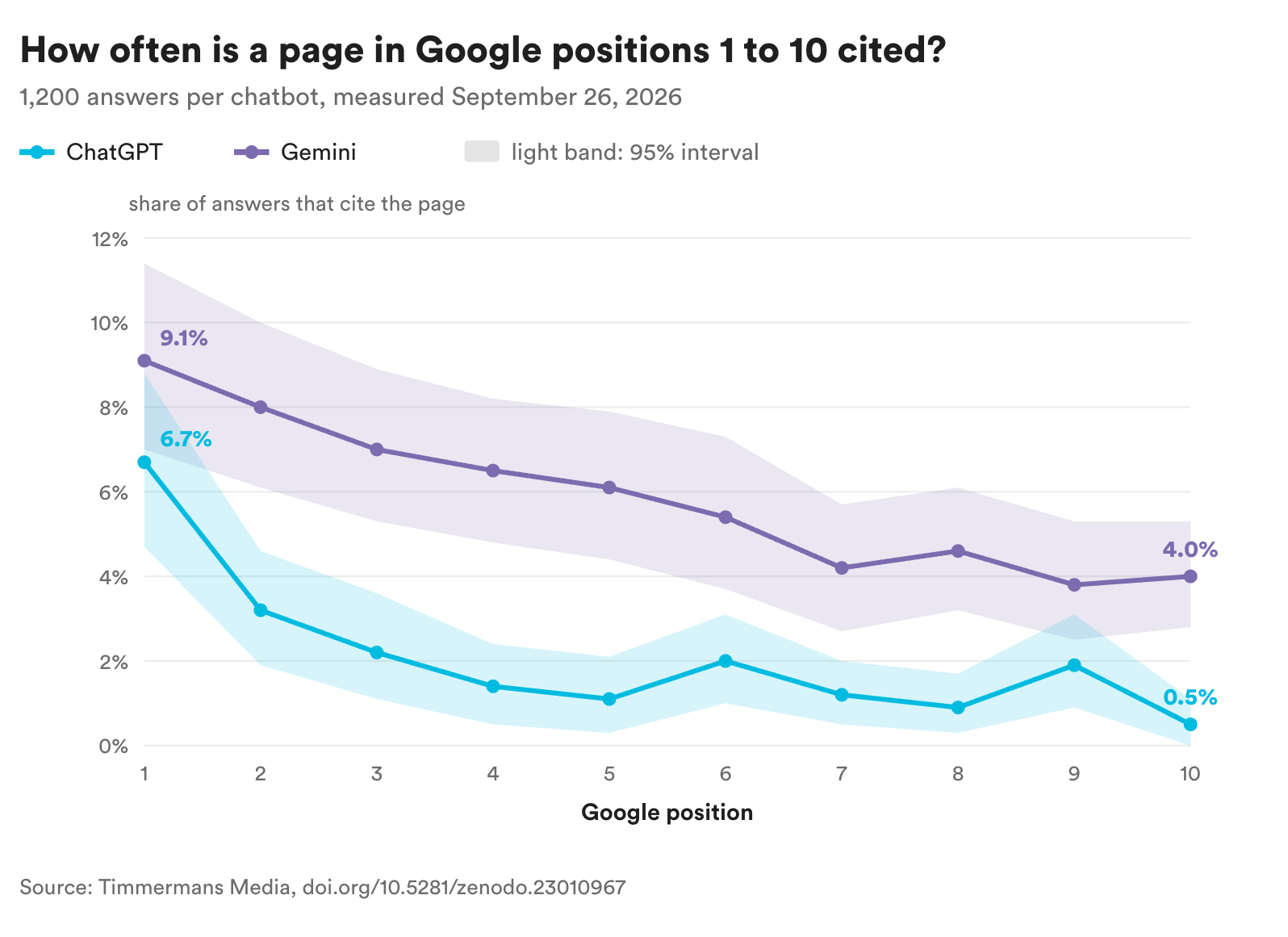
Chart 1. Share of all 1,200 answers per chatbot that list the page at that Google position as a source, weighted average, with 95% intervals. Measured September 26, 2026. Conclusion: higher-ranked pages are cited more often, but even the No. 1 result goes uncited in most answers.
Its own search queries
How does ChatGPT find its sources for an answer?
With many search queries of its own, which differ from the user's question. For purchase questions, the API logged an average of 9.5 search queries per answer. In 84% of the purchase answers in which ChatGPT searched, at least one query contained a brand name the user had not mentioned.
| ChatGPT | Gemini | Perplexity | |
|---|---|---|---|
| Search queries per answer to a purchase question (average) | 9.5 | 0.8 | 2.4 |
| Search queries per answer to an informational question (average) | 4.1 | 0.3 | 0.7 |
| Purchase answers with a brand name in a search query | 84% | 36% | 43% |
First two rows: average per answer (each question was asked three times), across all answers, including answers without a search (those count as 0), weighted by category and question type. Exploratory. Third row: share of the purchase answers in which the chatbot searched (ChatGPT 687, Gemini 239, Perplexity 553). Brand name: a brand that was not in the question. For Gemini, the Health and wellbeing category is missing because Gemini did not search on purchase questions there.
ChatGPT often uses the site: search operator, which searches within a single website, as in “site:moneybird.nl tarieven” (“tarieven” is Dutch for rates). A site: query on a brand's own website appeared in 67% of purchase answers (weighted by category; unweighted 473 of 687 purchase answers, 69%). ChatGPT searched in all 687 purchase answers.
Example: one purchase question, the Google results, and ChatGPT's search queries
The question: “Ik drink twee koppen koffie per dag en woon alleen. Wat is de bestekoffiemachine?” (“I drink two cups of coffee a day and live alone. What is the best coffee machine?”)
The linked Google search term: “beste koffiemachine woon alleen” (“best coffee machine live alone”)
Google's top 10 for that search term on September 26, 2026:
| Position | Result (cleaned URL) |
|---|---|
| 1 | consumentenbond.nl/espressomachine/beste/volautomaat |
| 2 | mediamarkt.nl/nl/content/keuken/koffie-espresso/beste-koffiemachine-met-bonen |
| 3 | coffeeness.de/nl/koffiezetapparaat-bonen |
| 4 | ad.nl/wonen/het-kost-een-paar-centen-maar-dan-heb-je-ook-wat-dit-is-de-beste-koffiemachine~a8734845 |
| 5 | gathering.tweakers.net/forum/list_messages/2275574 |
| 6 | koffie.nl/beste-koffiemachines-voor-thuis |
| 7 | zwarteroes.nl/blogs/koffie-benodigdheden/de-3-beste-koffiezetapparaten-voor-een-persoon |
| 8 | fleurdecafe.nl/koffiemachine-met-bonen-voor-thuis |
| 9 | coolblue.nl/advies/volautomatische-espressomachine-kiezen.html |
| 10 | fashionchick.nl/reviews/beste-koffiezetapparaat |
The search queries the API logged for this answer:
- 1site:nespresso.com/nl/nl Essenza Mini 2 kopgroottes 19 bar prijs
- 2site:delonghi.com/nl-nl Magnifica Start ECAM220 prijs onderhoud bonen koffiemachine
- 3site:philips.nl Senseo Original Plus koffiemachine twee kopjes tegelijk prijs
- 4site:moccamaster.eu cup one 300 ml koffiezetapparaat specificaties nederland
- 5site:moccamaster.eu/nl cup one prijs 300 ml
- 6site:philips.nl/c-p/CSA210_
- 7site:nespresso.com/nl/nl/koffie original capsules vanaf prijs espresso lungo
- 8site:philips.nl senseo original plus csa210 prijs koffiepad
The sources in the answer: moccamaster.eu/cup-one-matt-black-69221, philips.nl/c-p/CSA210_40R1/original-plus-coffee-pad-machine, and nespresso.com/nl/nl/koffiemachines/essenza-mini. None of those pages or websites appears in Google's top 10 for the linked search term.
This is a single example (answer P12C02, ChatGPT, first run in the data repository), chosen because the pattern is easy to see in it. All eight logged search queries target a brand and a model, on the brand's own website. None of them matches the generic search term we used to query Google (“beste koffiemachine woon alleen”).
Exploratory: in about 42% of purchase answers, a brand name already appears in the first logged search query. Whether ChatGPT actually ran the queries in that order cannot be proven. So we cannot establish whether ChatGPT picks brands before it reads sources. Nor did we measure how a brand ends up in those search queries.
Purchase answers with a brand name in a search query
Chart 2. Share of purchase answers that involved searching with at least one search query containing a brand name that was not in the question. Denominators: ChatGPT 687, Perplexity 553, Gemini 239 purchase answers. With 95% intervals. Measured September 26, 2026. Conclusion: in purchase answers that involve searching, ChatGPT's search queries contain a brand name far more often than those of Gemini and Perplexity.
Page or website
Does ChatGPT cite the same page Google shows, or only the same website?
The same website more often than the same page. Little overlap at the page level therefore does not mean ChatGPT uses entirely different websites. Even so, the overlap at the website level remains limited.
Comparison 1: how often does a result from Google's top 3 come back as a source?
| ChatGPT | Gemini | |
|---|---|---|
| The exact page cited | 4.0% | 8.1% |
| The website of that page cited | 10.8% | 11.5% |
Average share of all 1,200 answers per chatbot, per top 3 result. The first row is the primary measure. The website level was preregistered as a second measure and is reported as exploratory.
Comparison 2: how many of the chatbot's sources rank in Google's top 10?
| ChatGPT | Gemini | |
|---|---|---|
| Cited pages that rank in Google's top 10 | 11.1% | 31.8% |
| Cited websites that rank in Google's top 10 | 33.2% | 46.8% |
Average share per answer with sources (ChatGPT 1,115 answers, Gemini 330). First row: secondary hypothesis. Second row: exploratory.
The primary measure counts only the exact page. A source on the same website but on a different page does not count as a match there. For ChatGPT, the website of a top 3 page is cited more than twice as often as the page itself. At the same time, on average two thirds of the websites ChatGPT cites in an answer do not appear in Google's top 10 for the linked search term.
Gemini
What changes for Gemini if you count only answers with sources?
Then Gemini looks much more like Google. Gemini listed sources in 330 of 1,200 answers (27.5%), for 138 of the 400 questions. The other answers count as “not cited” in the primary measure, which pulls the average down. In this measurement, those were the same 330 answers in which Gemini ran a search.
| All 1,200 answers | Only answers with sources | |
|---|---|---|
| ChatGPT | 4.0% | 4.5% (1,115 answers) |
| Gemini | 8.1% | 34.8% (330 answers for 138 questions) |
Average share of answers that cite one specific page at position 1, 2, or 3. The right-hand column is a supplementary measure that was not preregistered.
The 34.8% cannot be derived from 8.1% and 330 of 1,200. The calculation uses only the 138 questions for which Gemini listed sources at least once, and per question only the answers with sources. The same weighting by category and question type was then applied to the combinations in which such questions occur; 7 of the 40 combinations are missing. So the figure says something about those 138 questions, not about all 400.
In 207 of the 330 Gemini answers with sources (63%, unweighted, supplementary), at least one top 3 page is among the sources. Of all pages Gemini cites, 32% on average rank in Google's top 10, versus 11% for ChatGPT. Compared on the same 138 questions, Gemini is 14.7 percentage points higher (95% interval 11.1 to 18.4).
According to Google's documentation, Gemini searches through Google Search. OpenAI does not disclose which search index ChatGPT uses.
Chart 3. Average share of answers that cite one specific page at position 1, 2, or 3, across all answers and across only the answers with sources, with 95% intervals. The second measure is supplementary and was not preregistered. Measured September 26, 2026. Conclusion: count only the answers with sources, and Gemini looks much more like Google.
For SEO specialists
What does this mean for the work of an SEO specialist?
That you need to broaden your analysis. A Google ranking for a generic search term and a citation in a chatbot are two different things, and you need to measure them separately. This study does not deliver a proven method for getting cited more often. It does show where to look.
| Task | How to apply this study |
|---|---|
| Visibility reporting | Measure Google rankings and citations separately, and per chatbot. In this measurement the overlap differed sharply between ChatGPT and Gemini. |
| Competitor research | Look at which pages the chatbots actually cite, even if they are not in the Google results for your generic search term. |
| Content review | Check which product information, rates, or specifications show up in the chatbot's search queries, and whether that information is on your website. |
| Interpreting results | Distinguish between a missing citation and a missing brand mention or recommendation. This study is only about sources. |
This applies to Dutch-language questions through the APIs, measured on a single day. Whether a better Google ranking leads to more citations, we did not measure: this study compares two lists on one day and does not track pages as they rise or fall.
Whether small websites stand a chance as a source next to big names is covered in our study on the Google traffic of AI sources. How much the brands mentioned shift when you repeat the same question is covered in our study on the consistency of brand mentions.
Deep dive
Deep dive: industries, retrieved sources, and ChatGPT's own searches on Google
The three parts below are exploratory. They round out the picture, but they do not carry the main conclusion.
In which industries do AI sources overlap most with Google?
For Gemini, the local service providers category stands out: there, a top 3 page is cited in 28% of answers on average. For ChatGPT, no category is above 11%.
| Category | ChatGPT | Gemini |
|---|---|---|
| Local service providers | 8.2% | 27.8% |
| Children and family | 7.2% | 17.1% |
| Legal | 10.2% | 13.9% |
| Cars and mobility | 6.5% | 13.7% |
| Fashion and footwear | 0.5% | 1.4% |
| Pets | 1.2% | 0.9% |
Averages per page, like the primary measure. A selection of notable categories; the lowest for Gemini is Software and SaaS (0.0%, ChatGPT 2.5%). 20 questions per category, with purchase and informational questions weighted equally, so these are rough estimates.
How many top Google pages do ChatGPT and Perplexity find while searching?
Few here, too. Through the API, ChatGPT and Perplexity return a list of sources they found while searching (in the methodology: retrieved). These are URLs from their search results, not pages that are known to have been opened or read.
ChatGPT: a page from Google's top 3 is among the retrieved sources in 9.3% of the 1,200 answers on average. Of all retrieved pages, 2.1% on average rank in Google's top 10 (1,115 answers).
Perplexity: a page from Google's top 3 is among the retrieved results in 10.2% of answers on average. Of all retrieved pages, 8.7% on average rank in Google's top 10 (692 answers with search results). In our measurement setup, Perplexity's Agent API returned no source citations with the answer.
Which websites ChatGPT mostly finds, and why Reddit is often among them but almost never cited, is covered in our study on Reddit as an AI source.
Do ChatGPT's sources appear in the Google results for its own search queries?
Within the checked selection of search queries without site:, an average of 15% of the pages ChatGPT cited ranked in the matching Google top 10 (416 answers). For the generic search term, the figure for the same answers was 9.4%.
We retrieved the Google results for 1,735 search queries that the chatbots logged themselves. From all distinct search queries without site: in the baseline measurement, we drew a sample of 1,793 with a fixed seed, proportional to each chatbot's count and with no cap per answer; 1,735 returned results. For the 416 ChatGPT answers, this means an average of 1.8 of the 3.8 search queries without site: per answer were checked, out of an average of 9.1 search queries in total. Search queries with site: were not included.
| In the top 10 of the checked own search queries | In the top 10 of the generic search term | |
|---|---|---|
| ChatGPT | 15.0% | 9.4% |
| Gemini | 40.6% | 32.7% |
| Perplexity (retrieved results) | 16.4% | 9.2% |
Only answers for which we looked up the Google results of at least one of the chatbot's own search queries.
This is not a complete check. A cited page that does not match here may still appear in the Google results of a search query we did not check, such as the site: queries, which are especially common for ChatGPT. The rise from 9.4% to 15.0% fits the picture that ChatGPT searches with different search terms, but does not prove it. Whether the sources rank further down on Google, we did not measure.
Methodology
Methodology: comparing Google results with AI sources
Preregistration and the amendment on Google page 2
We recorded the research questions, hypotheses, measurement settings, and analysis rules and deposited them publicly on Zenodo before the measurement began (DOI 10.5281/zenodo.22974863).
Amendments, hypotheses, measurement setup, matching, weighting, and limitations
After the deposit, two rules were amended on September 26, 2026, both before any analyses had been run. Amendment 1 affects this publication. The Google API returned at most 10 regular results per search query, and fewer for 88 of the 400 search terms, presumably because other elements of the results page took up space. For those 88 we also retrieved the second page, so that every search term had a full top 10. The page 2 results were placed after those from page 1 and numbered consecutively. A URL that already appeared on page 1 counted only the first time; that happened 21 times, for 19 search terms. After merging, every search term had 13 to 19 results, so none stayed below 10.
Using only the 312 search terms that were already complete on page 1, the main conclusion holds. The percentages are then slightly higher: 4.5% for ChatGPT and 8.6% for Gemini, both confirmed. Amendment 2 concerns data from an external domain source and does not affect this publication. Both are in the amendment log in the data repository.
| Hypothesis | Content | Type | Outcome or estimate |
|---|---|---|---|
| H1a | A top 3 page is cited in fewer than 50% of answers | Primary | Confirmed for ChatGPT and Gemini |
| H1b | Fewer than 50% of cited pages rank in Google's top 10 | Secondary | ChatGPT 11.1% (9.2 to 13.1), Gemini 31.8% (29.5 to 34.3) |
| H1c | Gemini has a higher H1b value than ChatGPT | Secondary | Gemini 14.7 percentage points higher (11.1 to 18.4) |
| H12 | At least 20% of purchase answers with search queries include a brand name in a search query | Secondary | ChatGPT 84% (81 to 88), Gemini 36% (30 to 42), Perplexity 43% (39 to 48) |
We had specified in advance that a Google ranking is “demonstrably insufficient” for a citation if a top 3 page is cited in fewer than half of the answers. That threshold is generous; both chatbots stay far below it. H1a is confirmed for both chatbots, with a corrected p-value of 0.001. Only the primary hypothesis gets an outcome label. We report secondary hypotheses as an estimate with an interval. Perplexity is not part of H1a, because in our measurement setup the Agent API returned no source citations with the answer.
Exploratory or added afterward: the count of answers with at least one top 3 page, the figures per Google position, the measure on answers with sources, the number of search queries per answer, the chatbots' own search queries on Google, and the figures per question type and industry.
Measurement setup with Google reference
| Questions | 400 Dutch-language questions without a brand name, 20 per category across 20 categories. 229 commercial, 171 informational |
|---|---|
| Google reference | For each question, a search term linked in advance, retrieved through a Google search results API (Google Netherlands, Dutch language, desktop) on September 26, 2026. Only regular (organic) results count as a position |
| Chatbots | ChatGPT (gpt-6-sol, OpenAI Responses API with web_search, location Netherlands), Gemini (gemini-3.8-flash, Gemini API with Google Search), Perplexity (sonar, Agent API with web_search, location Netherlands) |
| Settings | No system prompt, default settings, each question in a new session |
| Runs | 3 per question per chatbot: 1,200 answers per chatbot |
| Measured | September 26, 2026, with Google results from the same day |
How we match pages
A cited page and a Google result count as the same if their URLs are identical after cleaning. In cleaning, we remove the protocol, www., a trailing slash, and known tracking parameters such as utm_source. ChatGPT, for example, adds utm_source=openai to many links. Substantive parts of the URL are kept. For Gemini, we use the actual destination URL behind the redirect link.
Weighting, intervals, and correction
For each question we average over the three runs. We then average by category and question type, giving every category the same weight. The intervals come from a bootstrap with 2,000 resamples, stratified by category and question type. Because we test the hypothesis for two chatbots, we correct the p-values with the Holm method.
Limitations of the Google comparison
- API, not the apps. The results apply to the API settings studied.
- One Google search term per question. We linked each question to one search term. A user googling on their own may use other words, and so do the chatbots.
- Gemini lists few sources. That makes the primary measure low for Gemini. The supplementary measure on answers with sources was not preregistered.
- Brand names in search queries were detected automatically. For site: queries, a fixed rule or a language model mapped the domain to a brand. This was not checked by humans.
- The chatbots' own search queries are a selection. We retrieved Google results for 1,735 search queries without site:, not for all of them.
- Overlap, not cause. We compare the chatbots' sources with same-day Google results. Whether a higher Google ranking leads to more citations does not follow from this.
- One point in time. This reflects the situation on September 26, 2026.
Open data
Data and how to cite the Google study
The preregistration (10.5281/zenodo.22974863) and the data repository (10.5281/zenodo.23010967) are on Zenodo. The answers, the Google results per search term and per search query the chatbots ran themselves (organic list with position and cleaned URL), and the analysis scripts are in the data repository. We do not share the raw API responses from the Google measurement, but we do share the results list derived from them and the control figures.
The data are licensed under CC BY 4.0, the analysis scripts under MIT.
Preregistration and data on Zenodo
Cite this study
Timmermans, M. (2026). Does ChatGPT use Google results? What 1,200 answers show. Timmermans Media. Measured September 26, 2026. Preregistration: doi.org/10.5281/zenodo.22974863. Data: doi.org/10.5281/zenodo.23010967. License CC BY 4.0. timmermansmedia.com/research/google-rankings-ai-sources/
This study is available under the CC BY 4.0 license.
Frequently asked questions
Questions about Google rankings and AI citations
What does "4% of answers on average" mean?
It is the probability that one specific page from Google's top 3 is listed as a source in a ChatGPT answer to the same question, averaged over the three positions and over 400 questions. Answers without a source count as not cited. The figure is weighted so that every category counts equally; unweighted, it is 3.8%. That is different from the share of answers in which at least one of the three top pages appears as a source: that is 10.7% (128 of 1,200).
Is SEO still worth it if AI only partly follows Google's results?
This study gives no reason to stop doing SEO. Higher-ranked pages were cited more often than lower-ranked ones, and for Gemini the overlap with Google was large in the answers with sources. What it does show is that a high ranking for one generic search term is not the same as a citation in ChatGPT. So measure the two separately.
Does ChatGPT use Google search results?
OpenAI does not disclose that. In our data, ChatGPT's sources overlap little with the Google results for the linked search term. For a subset of ChatGPT's own search queries the overlap was somewhat higher (15%), but that is not a complete check.
Why is Perplexity left out of the main test?
In our measurement setup, Perplexity's Agent API returned no source citations with the answer. For Perplexity we therefore report only the sources it found while searching, as a separate measure.
Does this also apply to Google AI Overviews?
We did not study those.
Can you measure whether my Google rankings show up in AI answers?
Yes. Using the same measurement setup, we can measure for your keywords whether your Google rankings also carry over into ChatGPT, Gemini, and Perplexity. See our GEO service.
Related research
Research · same measurement
How consistent are AI brand mentions? A study of 60 buying questions
The same measurement: 60 purchase questions, each asked 8 times, to see how much the brands mentioned vary from answer to answer.
Research · same measurement
Does llms.txt work for AI citations? A study of 3,048 websites
The same measurement: we checked 3,048 cited and uncited websites for an llms.txt file.
Research · same measurement
Does ChatGPT cite small websites? A study of 400 questions
The same 400 questions, with the estimated Google traffic of every cited website. Many of these websites get cited, but each in only a few answers.
Research
Does ChatGPT use Reddit as a source? What 3,600 AI answers show
The same measurement, focused on Reddit and on retrieved versus cited sources.
Research
AI hallucination rates by model: 1,917 answers about 37 Dutch brands
1,917 AI answers about 37 Dutch brands, tested against verified facts.
This page is the English edition of a study first published in Dutch. Read the original Dutch version.
Glossary
Dutch terms on this page
The study used Dutch questions and Dutch websites. These are the Dutch names and words that come up.
- AD
- Dutch national daily newspaper (Algemeen Dagblad), owned by DPG Media.
- Consumentenbond
- Dutch consumer association that tests products and services, comparable to Consumer Reports.
- Coolblue
- Dutch online electronics and appliance retailer, comparable to Best Buy.
- Fashionchick
- Dutch fashion and lifestyle website with product reviews.
- Fleur de Café
- Dutch online retailer of coffee machines and coffee beans.
- Koffie.nl
- Dutch website with coffee machine guides; koffie means “coffee.”
- koffiemachine
- Dutch for “coffee machine.”
- koffiepad
- Dutch for “coffee pad,” a single-serve pod.
- koffiezetapparaat
- Dutch for “coffee maker.”
- MediaMarkt
- European consumer electronics chain with large Dutch stores, comparable to Best Buy.
- Moccamaster
- Dutch brand of premium filter coffee makers, sold in the US as Technivorm Moccamaster.
- Moneybird
- Dutch online invoicing and accounting software for small businesses, comparable to QuickBooks.
- onderhoud
- Dutch for “maintenance.”
- prijs
- Dutch for “price.”
- tarieven
- Dutch for “rates” or “prices.”
- Tweakers
- Dutch technology news and review site with a price comparison tool and a large forum.
- Zwarte Roes
- Dutch online shop for coffee equipment.

Do your Google rankings carry over into AI?
Get found on Google and cited by AI
For your keywords, we measure whether your Google rankings also show up in ChatGPT, Gemini, and Perplexity, and which pages the chatbots do cite.