Research · October 8, 2026
Does ChatGPT cite small websites? A study of 400 questions
400 Dutch-language questions without a brand name, 3 repetitions per chatbot, measured through the ChatGPT, Gemini, and Perplexity APIs. For every cited website, we looked up its estimated Google traffic from the Netherlands in Ahrefs.
Matt Timmermans, Timmermans Media. Measured: September 26, 2026. Preregistration: doi.org/10.5281/zenodo.22974863. Data: doi.org/10.5281/zenodo.23010967.
Does ChatGPT cite small websites? If small means little Google traffic, yes: of the unique websites ChatGPT cited in this measurement, 37% got little estimated Google traffic from the Netherlands (fewer than 1,000 visits per month). Per answer, their share averaged 15%. Both numbers are correct: many of these websites get cited, but each one shows up in only a few answers.
That does not mean AI favors small businesses. We found no convincing evidence that websites with little Google traffic make up a larger share of ChatGPT's sources than of the Google top 10. And little Google traffic is not the same as small: this group includes local businesses, but also large foreign institutions. The results apply to the APIs on September 26, 2026; the apps were not studied.
The findings
Websites with little Google traffic in AI answers: four figures
per website:
of the 676 unique websites ChatGPT cited, 249 got little Google traffic. For Gemini, it was 470 of 1,053 (45%).
per answer:
in the average ChatGPT answer, 14.8% of the cited websites got little Google traffic. For Gemini, 24.3%, across the answers that included sources.
1.6 versus 9.3 answers:
ChatGPT cited a website with little Google traffic in 1.6 answers on average, and a website with 100,000 or more estimated monthly visits in 9.3.
Comparison with Google inconclusive:
the test of whether AI cites these websites more often than Google shows them in its top 10 was inconclusive for both ChatGPT and Gemini.
In short: across 400 Dutch-language questions, each asked three times through the API, 37% of the unique websites ChatGPT cited had fewer than 1,000 estimated visits per month from Google Netherlands. Per answer, their share averaged 15%. Measured September 26, 2026. The study measures which websites get cited, not why, and not how large the business behind them is.
The full study this publication is part of consists of 6,120 answers. This publication uses the baseline measurement: 400 questions, 3 repetitions, 1,200 answers per chatbot, supplemented with Ahrefs data on the cited websites and the Google top 10. Per-answer percentages are weighted across categories and question types.
Definition
What is a website with little Google traffic?
A website that, according to Ahrefs, gets fewer than 1,000 estimated visits per month from Google Netherlands through regular search results. The methodology calls this “low-visibility.”
Three things to keep in mind:
It is an estimate. Ahrefs estimates visits based on rankings and search volumes. It is not a measured visitor count.
It is about the Netherlands. A website with lots of traffic from other countries can still have little Google traffic in this measurement.
It says nothing about company size. The UK's National Health Service (nhs.uk) falls into this group, and so does a hair salon with a single location.
Two ways of counting
How often do ChatGPT and Gemini cite websites with little Google traffic?
It depends on how you count. Per unique website, it is just over a third for ChatGPT. Per answer, it is about one in seven.
| Per unique website | Per answer (average) | |
|---|---|---|
| ChatGPT | 36.8% (249 of 676) | 14.8% |
| Gemini | 44.6% (470 of 1,053) | 24.3% |
Per website: each website counts once, no matter how often it was cited; 95% intervals 33.3 to 40.5% and 41.9 to 47.8% (secondary hypothesis). Per answer: share among the sources of an answer, averaged over the answers with usable sources and weighted across categories and question types. Excludes forums, video, social media, and websites without Ahrefs data.
The two columns answer different questions:
Per website: what share of all websites that were ever cited gets little Google traffic?
Per answer: what share of the sources in an average answer gets little Google traffic?
The gap comes from repetition. ChatGPT cited a website with little Google traffic in 1.6 answers on average (median 1), and a website with 100,000 or more estimated monthly visits in 9.3 answers (median 3). For Gemini, it is 1.6 versus 5.6. Websites with little traffic are numerous on the list, but each one appears in only a few answers (supplementary, not preregistered).
For ChatGPT and Gemini combined, that comes to 673 of the 1,569 unique websites (42.9%). We had set 10% in advance as the threshold for “present to a meaningful extent”; both chatbots are well above it.
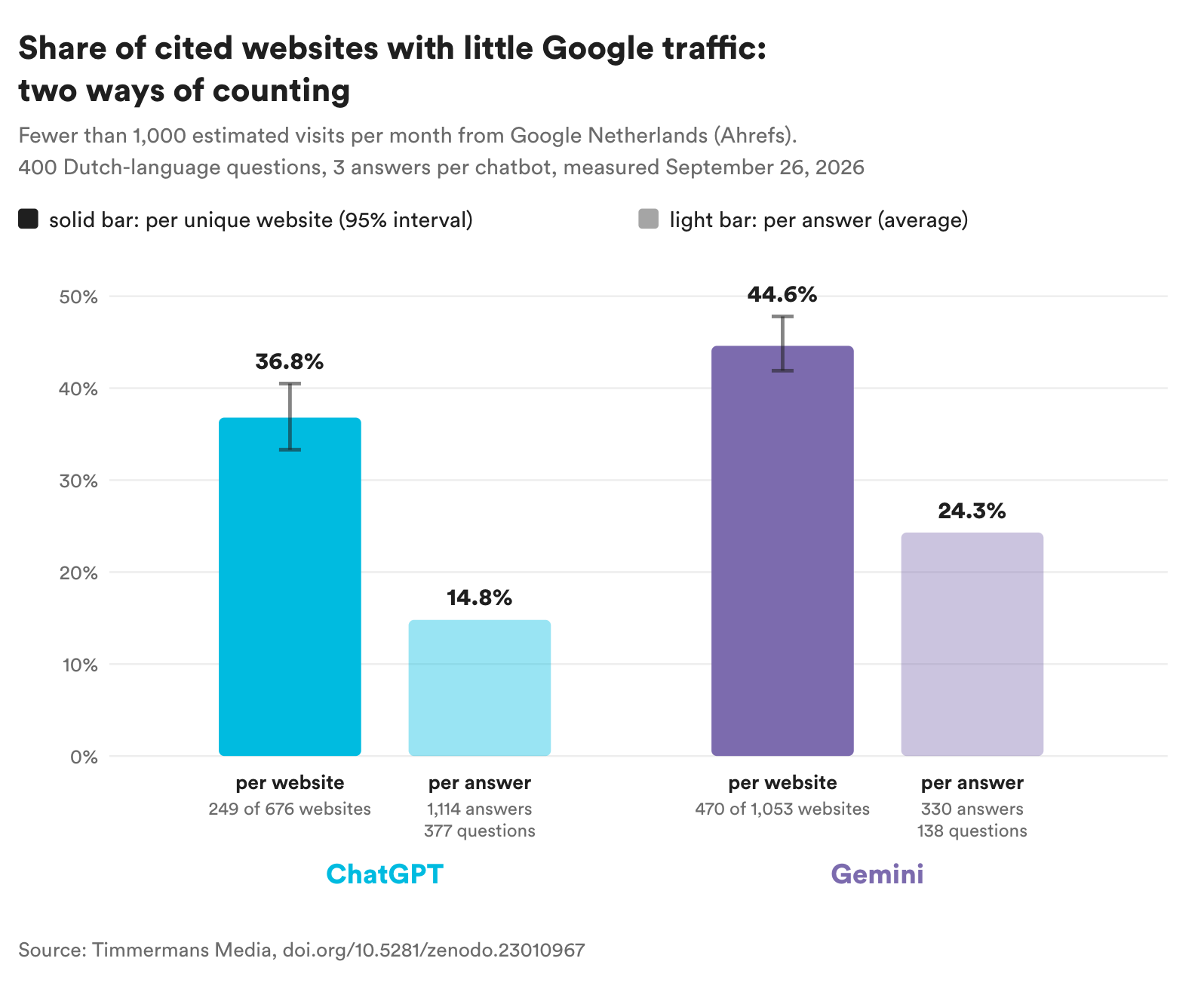
Figure 1. Share of cited websites with little Google traffic (fewer than 1,000 estimated visits per month from Google Netherlands), counted two ways: per unique website (ChatGPT 249 of 676, Gemini 470 of 1,053, with 95% interval) and per answer, averaged over the answers with usable sources (ChatGPT 1,114 answers across 377 questions, Gemini 330 answers across 138 questions; no interval exists for this figure). Measured September 26, 2026.
Cited websites by traffic tier
| Estimated monthly visits from Google NL | ChatGPT | Gemini | Google top 10 |
|---|---|---|---|
| Very low (fewer than 100) | 22.0% | 22.7% | 9.3% |
| Low (100 to 1,000) | 14.5% | 21.7% | 19.0% |
| Medium (1,000 to 10,000) | 19.9% | 25.1% | 32.1% |
| High (10,000 to 100,000) | 26.5% | 20.6% | 27.5% |
| Very high (100,000 or more) | 16.1% | 9.4% | 11.9% |
| No data | 1.0% | 0.5% | 0.2% |
Exploratory. Share of unique websites per tier: 683 for ChatGPT, 1,058 for Gemini, and 2,069 in the Google top 10 for the 400 search terms. These counts are slightly higher than above because websites without data are included here (7, 5, and 5).
ChatGPT cites websites from the very low and very high tiers more often than they appear in the Google top 10, and websites from the low and medium tiers less often.
Figure 2. Share of unique websites per traffic tier (estimated visits per month from Google Netherlands), in %, for the sources cited by ChatGPT (683 websites), the sources cited by Gemini (1,058), and the Google top 10 for the 400 search terms (2,069). The “no data” tier (1.0%, 0.5%, and 0.2%) is not shown. Exploratory. Measured September 26, 2026.
Comparison with Google
Does ChatGPT favor small websites over the Google top 10?
We could not demonstrate that. We found no convincing evidence that websites with little Google traffic make up a larger share of ChatGPT's sources than of the Google top 10. For Gemini, their share was higher, but the test was not allowed to run there. The preregistered outcome is inconclusive for both chatbots.
For each question, we compared two shares: the share of websites with little Google traffic among the sources of an AI answer, and the same share in the Google top 10 for the matched search term.
| Chatbot | Share among AI sources | Share in the Google top 10, same questions | Difference (95% interval) | Outcome |
|---|---|---|---|---|
| ChatGPT | 14.8% | 17.3% | -2.5 percentage points (-4.8 to -0.1) | Inconclusive |
| Gemini | 24.3% | 17.6% | +6.7 percentage points (+4.8 to +8.5) | Inconclusive due to insufficient coverage |
Averaged per answer, then per question, weighted across categories and question types. Usable after all filters: for ChatGPT, 1,114 answers across 377 questions; for Gemini, 330 answers across 138 questions. The Google share is calculated over the same questions as the comparison, with the same weighting (supplementary, not preregistered). Across all 400 questions, it is 17.1%. The intervals are not adjusted for multiple testing; the p-value is.
ChatGPT. The estimate is slightly below zero. The adjusted p-value is 0.078, just above the 0.05 threshold, so the outcome is inconclusive. The data do not support the idea that ChatGPT cites websites with little Google traffic more often than Google shows them. That ChatGPT cites them less often has not been demonstrated either.
Gemini. The estimate is above zero. But Gemini listed sources in only 330 of its 1,200 answers, and in 7 of the 40 combinations of category and question type it listed none at all. Under the preregistered rule, the test may not be run in that case. The 6.7 percentage points describe the answers that included sources and are not a tested outcome.
This comparison is about the composition of two lists: the chatbot's sources and the Google top 10. It says nothing about any individual website's chance of being cited. How we tested is explained in the methodology.
For ChatGPT, the gap is largest on purchase questions
| ChatGPT | Gemini | |
|---|---|---|
| Purchase questions: difference with Google | -4.4 percentage points (-7.3 to -1.5) | +6.2 percentage points (+3.2 to +9.0) |
| Informational questions: difference with Google | -0.5 percentage points (-4.0 to +3.2) | +7.2 percentage points (+4.9 to +9.5) |
Exploratory. 95% intervals in parentheses. The difference between the two question types was not tested, and the intervals overlap.
On purchase questions, the share of websites with little Google traffic in ChatGPT answers was 4.4 percentage points below the share in the Google top 10. That fits with our study of Reddit as an AI source: the websites ChatGPT cites most often are big names such asRijksoverheid (the Dutch central government's website),Consumentenbond (the Dutch consumer association), and ANWB (the Dutch motoring association).
Examples
Which small websites do ChatGPT and Gemini cite?
A very mixed bunch. This group includes local businesses, such as hair salons and bookkeeping firms, but also foreign institutions with little Dutch search traffic and a lot of authority. For Gemini, it also includes Dutch comparison sites.
Two examples: a local business and a foreign institution
| piekfijnkappers.nl | nhs.uk | |
|---|---|---|
| Type | Local business (hair salon) | UK government (National Health Service) |
| Estimated monthly visits from Google NL | 21 | 0 |
| The question asked (translated from Dutch) | “I live in Winterswijk. How much does a perm cost at the hair salon?” | “I’m just starting to exercise after years of doing nothing. Is running good for you?” and “... What is zone 2 running?” |
| The cited page | piekfijnkappers.nl (the homepage) | nhs.uk/better-health/get-active/get-running-with-couch-to-5k and the schedule page below it |
| Number of answers citing the website | 3, for 1 question | 4, for 2 questions |
| Chatbot | ChatGPT | ChatGPT |
Baseline measurement, 1,200 ChatGPT answers. Counts: supplementary, not preregistered. Estimated visits: Ahrefs, as in the table below. Winterswijk is a small town in the east of the Netherlands.
Both fall into the same traffic tier, but they are very different sources. If you only look at traffic, you miss that difference.
A selection of cited websites with little Google traffic
| ChatGPT | Estimated monthly visits from Google NL | Domain Rating | Type of website |
|---|---|---|---|
| europeanpetfood.org | 38 | 75 | Trade association |
| wsava.org | 14 | 81 | International professional association |
| nhs.uk | 0 | 75 | UK government |
| payforpeople.nl | 786 | 44 | Brand |
| piekfijnkappers.nl | 21 | 6 | Local business |
| pitadministratie.nl | 57 | 4 | Local business |
| Gemini | Estimated monthly visits from Google NL | Domain Rating | Type of website |
|---|---|---|---|
| vergelijkdierenverzekering.nl | 74 | 36 | Comparison site |
| amsterdamcitysalon.nl | 63 | 0 | Local business |
| bestekeuze-autostoel.nl | 13 | 6 | Comparison site |
| klussendirect.nl | 941 | 28 | Comparison site |
| werkeninopvang.nl | 813 | 0 | Industry blog |
| efsim.nl | 0 | 7 | Brand |
Exploratory. A selection from the 30 most-cited websites with little Google traffic per chatbot. Domain Rating is Ahrefs' measure of link profile strength, from 0 to 100. The “type of website” column is our own description.
We did not count how many of the websites with little Google traffic belong to small businesses.
For SEO specialists
Do you need Google traffic to get cited by ChatGPT?
Not in this measurement: 249 of the 676 unique websites ChatGPT cited had fewer than 1,000 estimated monthly visits from Google Netherlands. For SEO specialists, the lesson is to evaluate claims about AI visibility more critically. This study does not offer a method for getting cited more often. It does show how to read numbers about cited websites.
| Task | How to apply this study |
|---|---|
| Source research | Don't rule out websites just because they have little estimated Google traffic. Websites like that showed up as sources in this measurement. |
| Reporting | Show both how many unique websites appear and how often they come back. Both numbers are correct, but they answer different questions. |
| Competitive analysis | Within the same traffic tier, distinguish between local businesses, brands, and international institutions. |
| Client advice | Don't present the presence of low-traffic websites as proof that AI favors small businesses. |
This applies to Dutch-language questions through the APIs, measured on a single day. Whether a website can do anything to get cited more often is something we did not study.
How often a page from the Google top 3 itself shows up as a source is covered in our study of Google rankings and AI sources. Whether having an llms.txt file is associated with citations is covered in our study of llms.txt and AI sources.
Deep dive
Deep dive: link profiles, local service providers, and Perplexity
The three parts below are exploratory. They round out the picture, but the main conclusion does not rest on them.
The link profile of cited websites
The median Domain Rating of the websites ChatGPT cites is 63. For Gemini, it is 32, and in the Google top 10, 37.
| Median Domain Rating | Middle half | Median number of Google keywords | |
|---|---|---|---|
| ChatGPT | 63 | 33 to 78 | 587 |
| Gemini | 32 | 11 to 57 | 284 |
| Google top 10 | 37 | 21 to 58 | 826 |
Per unique website. Not tested.
This is a description. It does not prove that ChatGPT selects by Domain Rating or that link building leads to more citations. ChatGPT cites many government sources, consumer organizations, and international institutions, and those have strong link profiles. ChatGPT also listed sources for far more questions than Gemini (377 versus 138 questions), so the two sets of websites are not directly comparable.
Local service providers and other categories
In the local service providers category, such as hair salons, landscapers, and painters, the share of websites with little Google traffic was 19.5 percentage points above the Google top 10 for ChatGPT, and 10.0 percentage points above it for Gemini.
| Category | ChatGPT: difference with Google | Gemini: difference with Google |
|---|---|---|
| Local service providers | +19.5 percentage points | +10.0 percentage points |
| Home and interior | +22.0 percentage points | +19.8 percentage points |
| Health and wellbeing | -21.5 percentage points | +9.1 percentage points |
| Education and courses | -15.8 percentage points | +2.7 percentage points |
A selection of notable categories. Usable questions per category: 18 to 19 for ChatGPT, 6 to 16 for Gemini. For Gemini, Health and wellbeing rests on informational questions only. No intervals per category, so these are rough estimates.
The differences per category vary widely, in both directions. With 6 to 19 usable questions per category and no intervals, this is a reason to measure local questions separately, not evidence that local businesses have an edge in AI.
The websites Perplexity finds while searching
Of the websites Perplexity finds per answer while searching (in the methodology: retrieved), an average of 26.1% get little Google traffic, compared with 20.1% in the Google top 10 for the same questions. In our setup, Perplexity's Agent API did not return citations with the answer, so here we look at retrieved websites. Whether Perplexity actually uses those websites in its answer cannot be determined.
| Perplexity (retrieved websites) | Value | 95% interval |
|---|---|---|
| Little Google traffic, per answer | 26.1% | 24.1 to 28.3% |
| Little Google traffic, in the Google top 10 | 20.1% | 18.7 to 21.6% |
| Difference | +6.0 percentage points | +3.7 to +8.4 |
| Little Google traffic, per unique retrieved website | 47.2% (1,133 of 2,401) | 45.3 to 49.1% |
Supplementary, not preregistered. Based on the 292 questions with usable Perplexity results. That is why the Google figure here is 20.1% and not 17.1%: it covers a different set of questions. The gap is largest on purchase questions (+8.7 percentage points).
Methodology
Methodology: measuring the Google traffic of cited websites
Preregistration and two amendments
We recorded the research questions, hypotheses, measurement settings, and analysis rules and deposited them publicly on Zenodo before the measurement began (DOI 10.5281/zenodo.22974863).
Amendments, hypotheses, setup, calculation method, and limitations
After the deposit, two rules affecting this publication were changed on September 26, 2026, both before any analyses had been run.
- Amendment 1: for 88 of the 400 search terms, we retrieved the second page of Google results because the first page did not yield a full top 10.
- Amendment 2: for some websites, Ahrefs returns traffic but no rank. Those websites were initially counted as “no data,” but that would have dropped precisely the websites with little traffic. We now assign them to a tier based on their traffic.
We reversed each change separately in two sensitivity analyses. The conclusion holds in both: ChatGPT inconclusive, Gemini inconclusive due to insufficient coverage.
| Analysis | ChatGPT: difference with Google | Gemini: difference with Google |
|---|---|---|
| Main analysis | -2.5 percentage points (-4.8 to -0.1) | +6.7 percentage points (+4.8 to +8.5) |
| Without amendment 1 | -0.9 percentage points (-3.1 to +1.5) | +8.8 percentage points (+7.0 to +10.5) |
| Without amendment 2 | -2.5 percentage points (-4.7 to -0.3) | +6.0 percentage points (+4.2 to +7.9) |
Without amendment 1, the ChatGPT difference is smaller and the interval includes zero. Both amendments are recorded in the amendment log in the data repository.
| Hypothesis | Content | Type | Outcome or estimate |
|---|---|---|---|
| H5a | Per answer, AI cites low-visibility websites more often than the Google top 10 shows them | Primary | ChatGPT inconclusiveGemini inconclusive due to insufficient coverage |
| H5b | At least 10% of the cited websites are low-visibility | Secondary | ChatGPT 36.8% (33.3 to 40.5), Gemini 44.6% (41.9 to 47.8) |
Only the primary hypothesis gets an outcome label. We report secondary hypotheses as an estimate with an interval. Exploratory or supplementary: the number of answers per website, the tier table, the comparison by question type and by category, the Domain Rating, and the Perplexity figures.
Why ChatGPT is inconclusive. We ran one two-sided test per chatbot: does the difference with Google deviate from zero? With an adjusted p-value below 0.05, the direction determines the outcome: a positive difference confirms the “more often” hypothesis, a negative difference rejects it. The adjusted p-value is 0.078, just above the preset threshold of 0.05. It depends on a choice we locked in before the analysis: because the Gemini test could not be run, it counts in the Holm correction with a p-value of 1. Had we corrected for ChatGPT alone, the p-value would have been 0.039. We stick to the preregistered rule and report this here.
Setup and Ahrefs data
| Questions | 400 Dutch-language questions without a brand name, 20 per category across 20 categories. 229 commercial, 171 informational |
|---|---|
| Chatbots | ChatGPT (gpt-6-sol, OpenAI Responses API with web_search, location Netherlands), Gemini (gemini-3.8-flash, Gemini API with Google Search), Perplexity (sonar, Agent API with web_search, location Netherlands) |
| Repetitions | 3 times per question per chatbot: 1,200 answers per chatbot |
| Google benchmark | Top 10 per question for a pre-matched search term, via the Serper API (Google Netherlands), September 26, 2026 |
| Google traffic | Ahrefs, estimated organic traffic per month from the Netherlands per website, retrieved on September 26, 27, and 28, 2026. 3,321 websites from the AI sources and the Google top 10, plus 1,455 websites retrieved by Perplexity |
| Tiers | Very low (fewer than 100), low (100 to 1,000), medium (1,000 to 10,000), high (10,000 to 100,000), very high (100,000 or more). Low-visibility, called “little Google traffic” in the text, is very low plus low |
We checked whether retrieving the Ahrefs data is reproducible. For traffic and rank, we re-retrieved a sample of 50 websites, and separately retrieved 100 websites in a different session. All numbers matched exactly. Domain Rating and keywords were retrieved in a second round and not checked separately. This checks the retrieval, not the accuracy of Ahrefs' estimates.
Additional Ahrefs data for Perplexity
For the Perplexity analysis, we enriched 1,455 additional websites with Ahrefs data. A sample of 30 of them was re-retrieved on all four fields; all 30 matched.
Without that extra enrichment, the result came out the other way (-6.1 percentage points instead of +6.0), because precisely the websites with little traffic did not have data yet. That is why we report only the complete version and mention the earlier result here.
Calculation per answer and per question
Per answer, we calculate the share of websites with little Google traffic among the unique sources, excluding forums, video, social media, and websites without data. An answer without such sources does not count as zero but as missing. Per question, we average across the repetitions and subtract the share in the Google top 10.
We then average per category and question type, with equal weight per category. The intervals come from a bootstrap with 2,000 resamples. Because we test the hypothesis for two chatbots, we adjust the p-values with the Holm method.
Limitations of the traffic measurement
- Traffic is not company size. We measure estimated search traffic from Google Netherlands. A large foreign company can have little Google traffic in our measurement.
- Ahrefs estimates. The numbers are model estimates of visits, not measured visitor counts.
- Composition, not probability. We compare the composition of two lists. We did not measure any individual website's chance of being cited.
- API, not the apps. The results apply to the API settings studied.
- Gemini lists few sources. As a result, the main test could not be run for Gemini.
- Perplexity: retrieved websites only. For Perplexity, we look at websites from the search results, not at sources cited in the answer.
- Interval for H5b. The interval across all websites does not account for the fact that websites cluster within questions. That is why we use it only descriptively.
- Website type determined automatically. Forums, video, and social media were excluded using a fixed list for a few well-known websites, such as reddit.com and youtube.com, and a classification by language models for the rest. That classification therefore affects the main results and was not checked by humans.
- One point in time. This is the state of play on September 26, 2026.
Open data
Data and citation for the study of the Google traffic of AI sources
The preregistration (10.5281/zenodo.22974863) and the data repository (10.5281/zenodo.23010967) are on Zenodo. The answers, the traffic tier per website as used in the analysis, and the analysis scripts are in the data repository. We do not share the raw Ahrefs data (traffic, rank, Domain Rating, and keywords per website) because of Ahrefs' terms; we do share the tiers, the checksums of the raw files, and the results of the checks.
The data are licensed under CC BY 4.0, the analysis scripts under MIT.
Preregistration and data on Zenodo
Cite this study
Timmermans, M. (2026). Does ChatGPT cite small websites? A study of 400 questions. Timmermans Media. Preregistration: doi.org/10.5281/zenodo.22974863. Data: doi.org/10.5281/zenodo.23010967. License CC BY 4.0. timmermansmedia.com/research/low-google-traffic-ai-sources/
This study is available under the CC BY 4.0 license.
Frequently asked questions
Questions about small websites as ChatGPT and Gemini sources
Can small websites get cited by ChatGPT?
Yes, in this measurement they did. Of the 676 unique websites ChatGPT cited, 249 (37%) had fewer than 1,000 estimated monthly visits from Google Netherlands, including a hair salon with a single location. But on average, each appeared in only 1.6 answers, so per answer their share averaged 15%.
Do small businesses get a better shot in AI than in Google?
This study does not show that. We found no convincing evidence that websites with little Google traffic make up a larger share of ChatGPT's sources than of the Google top 10. On top of that, little Google traffic is not the same as a small business, and we did not measure any individual website's chance of being cited.
Why is one figure 37% and the other 15%?
The 37% counts every website ChatGPT cited at least once exactly one time. The 15% is the share among the sources of an average answer. Websites with little Google traffic were cited in 1.6 answers on average, websites with 100,000 or more estimated monthly visits in 9.3.
Why is the ChatGPT result inconclusive when the difference is negative?
Because the adjusted p-value (0.078) sits just above the preset threshold of 0.05. The Gemini test could not be run, but it counts in the correction with a p-value of 1. Had we corrected for ChatGPT alone, the p-value would have been 0.039. The interval in the table is not adjusted; the p-value is.
Does ChatGPT select sources by Domain Rating?
We did not measure that. We only see that the websites ChatGPT cites have a higher median Domain Rating (63) than the websites in the Google top 10 (37). That is a description, not evidence that links lead to citations.
Do these numbers also apply to the ChatGPT and Gemini apps?
We did not study that. The measurement was done through the APIs, with default settings and the location set to the Netherlands.
Can you measure whether my website shows up in AI answers?
Yes. Using the same setup, we can measure whether your website appears as a source in ChatGPT, Gemini, and Perplexity for your industry and region. See our GEO service.
Related research
Research · same measurement
How consistent are AI brand mentions? A study of 60 buying questions
The same measurement: 60 purchase questions, each asked 8 times, to see how much the brands mentioned vary from answer to answer.
Research · same measurement
Does llms.txt work for AI citations? A study of 3,048 websites
The same measurement: we checked 3,048 cited and non-cited websites for an llms.txt file.
Research · same measurement
Does ChatGPT use Google results? What 1,200 answers show
The same 400 questions, set against the Google results from the same day.
Research · same measurement
Does ChatGPT use Reddit as a source? What 3,600 AI answers show
The same measurement, focused on Reddit and on retrieved versus cited sources.
This page is the English edition of a study first published in Dutch. Read the original Dutch version.
Glossary
Dutch terms on this page
The study used Dutch questions and Dutch websites. These are the Dutch names and words that come up.
- ANWB
- Dutch motoring and travel association with roadside assistance and consumer advice, comparable to AAA.
- bestekeuze-autostoel.nl
- Dutch comparison site; the name means “best choice car seat.”
- Consumentenbond
- Dutch consumer association that tests products and services, comparable to Consumer Reports.
- klussendirect.nl
- Dutch home repair comparison site; the name means “odd jobs direct.”
- piekfijnkappers.nl
- Dutch hair salon website; the name means “spick-and-span hairdressers.”
- pitadministratie.nl
- Dutch bookkeeping firm website; administratie means “bookkeeping.”
- Rijksoverheid
- Dutch central government's website for rules and public services, comparable to USA.gov.
- vergelijkdierenverzekering.nl
- Dutch comparison site; the name means “compare pet insurance.”
- werkeninopvang.nl
- Dutch industry blog; the name means “working in childcare.”
- Winterswijk
- Small town in the east of the Netherlands.

Does your website show up as a source in AI?
Measure your visibility in AI answers
We measure whether your website appears as a source in ChatGPT, Gemini, and Perplexity for your industry and region, and which websites the chatbots do cite.